Type Safety — E0010–E0029
Rules that catch type mismatches, incorrect annotations, and unsound type usage. For the complete, generated list of every code, see the rules overview.
← Missing Annotations | All Rules →
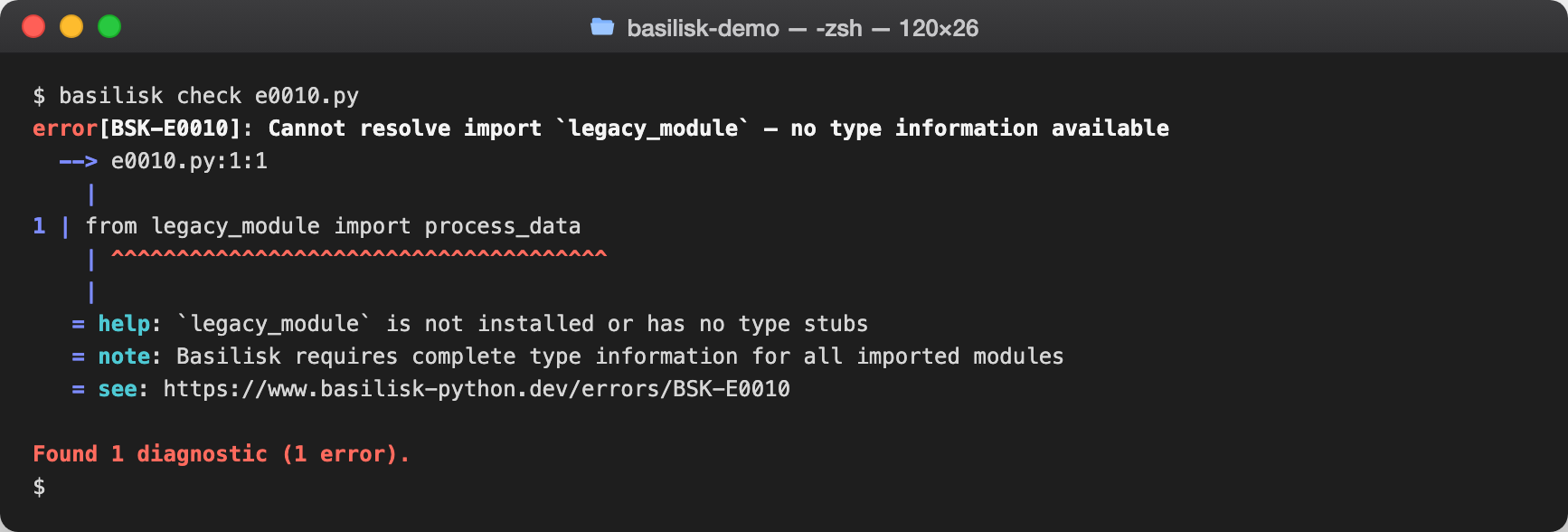
imports_unresolved — Unresolved import
An import refers to a module that cannot be resolved on the configured search paths.
# Error — module cannot be found
from legacy_module import process_data

# Fix — install the package / add it to the workspace, or point
# stub-paths at a .pyi for it
Real basilisk check output:
returns_compatibility — Explicit Any / return type mismatch
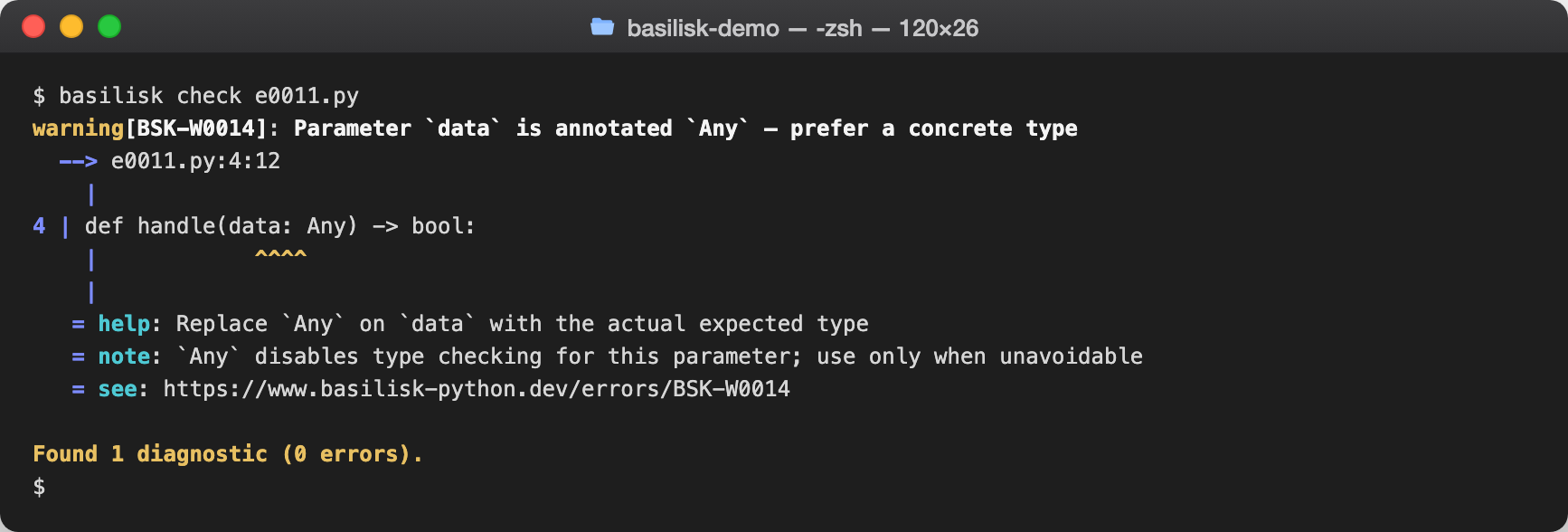
Two checks share this code. An explicit Any annotation silences type checking and must be justified; and a returned value that is clearly incompatible with the declared return type is reported.
from typing import Any

# Warning — explicit `Any` must carry a reason
def handle(data: Any) -> bool:
    return True
Real basilisk check output:
calls_argument_type — Argument type mismatch
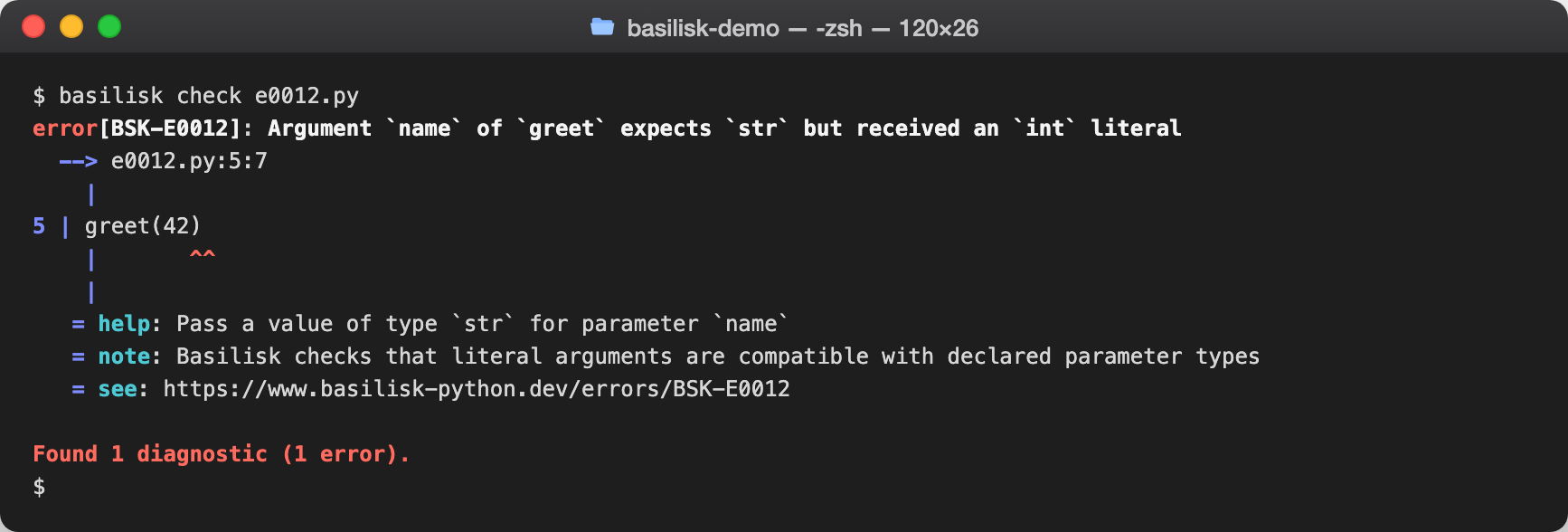
A function is called with an argument of the wrong type.
def greet(name: str) -> str:
    return f"Hello, {name}"

greet(42)  # Error — int is not str
Real basilisk check output:
returns_compatibility_2 — Return type mismatch
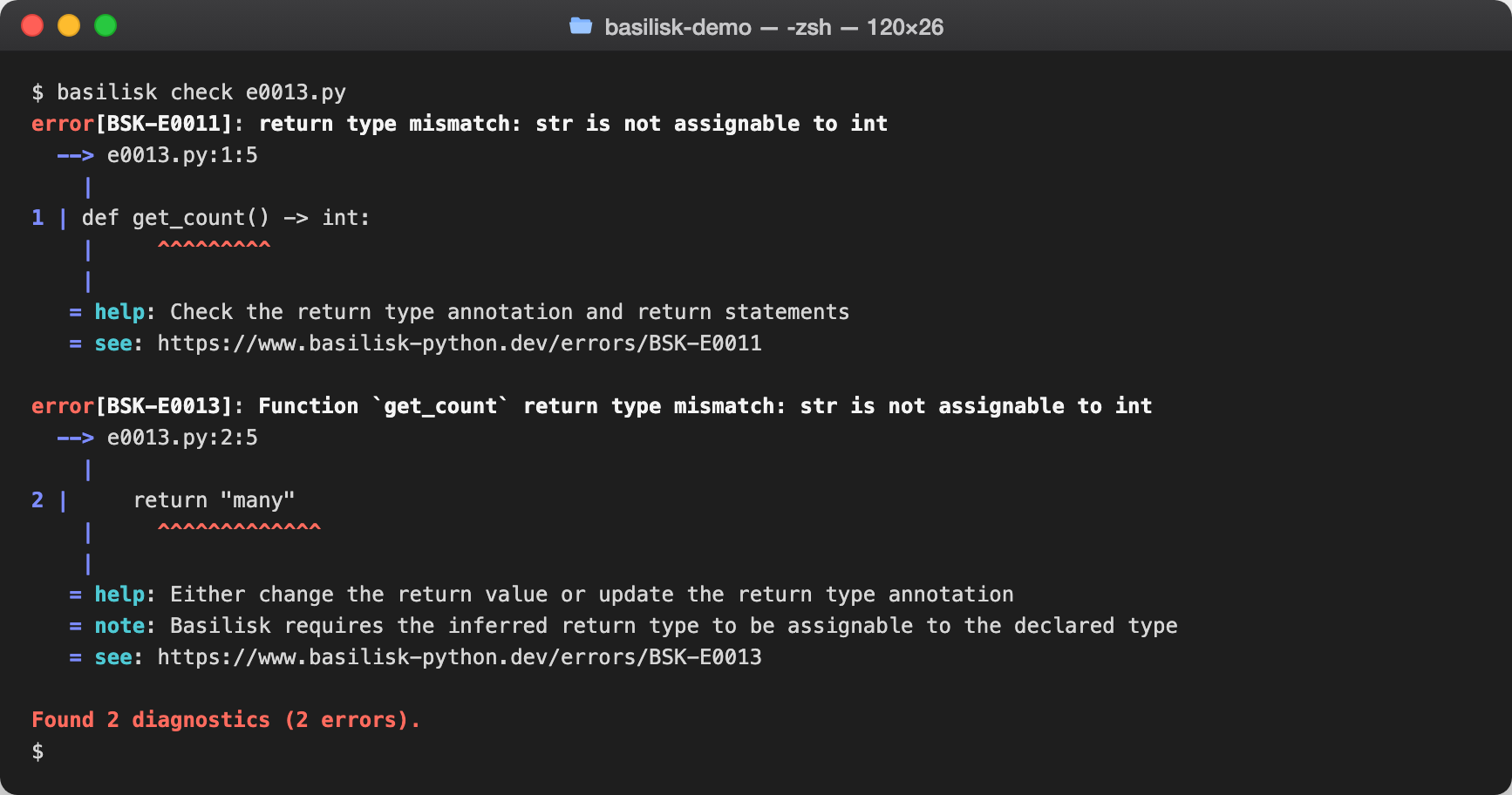
The type of a returned value does not match the declared return type.
def get_count() -> int:
    return "many"  # Error — str is not int
Real basilisk check output:
assignment_compatibility — Assignment incompatibility
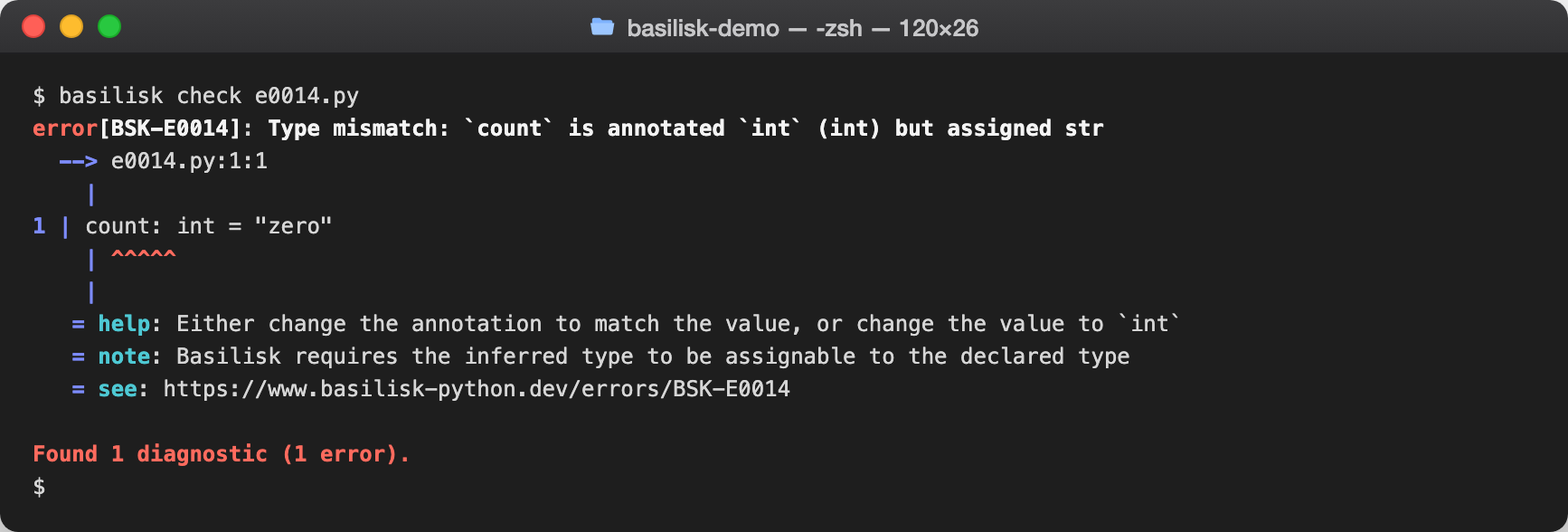
A value of the wrong type is assigned to an annotated variable.
count: int = "zero" # Error — str is not intReal basilisk check output:
callables_annotation — Invalid type argument count
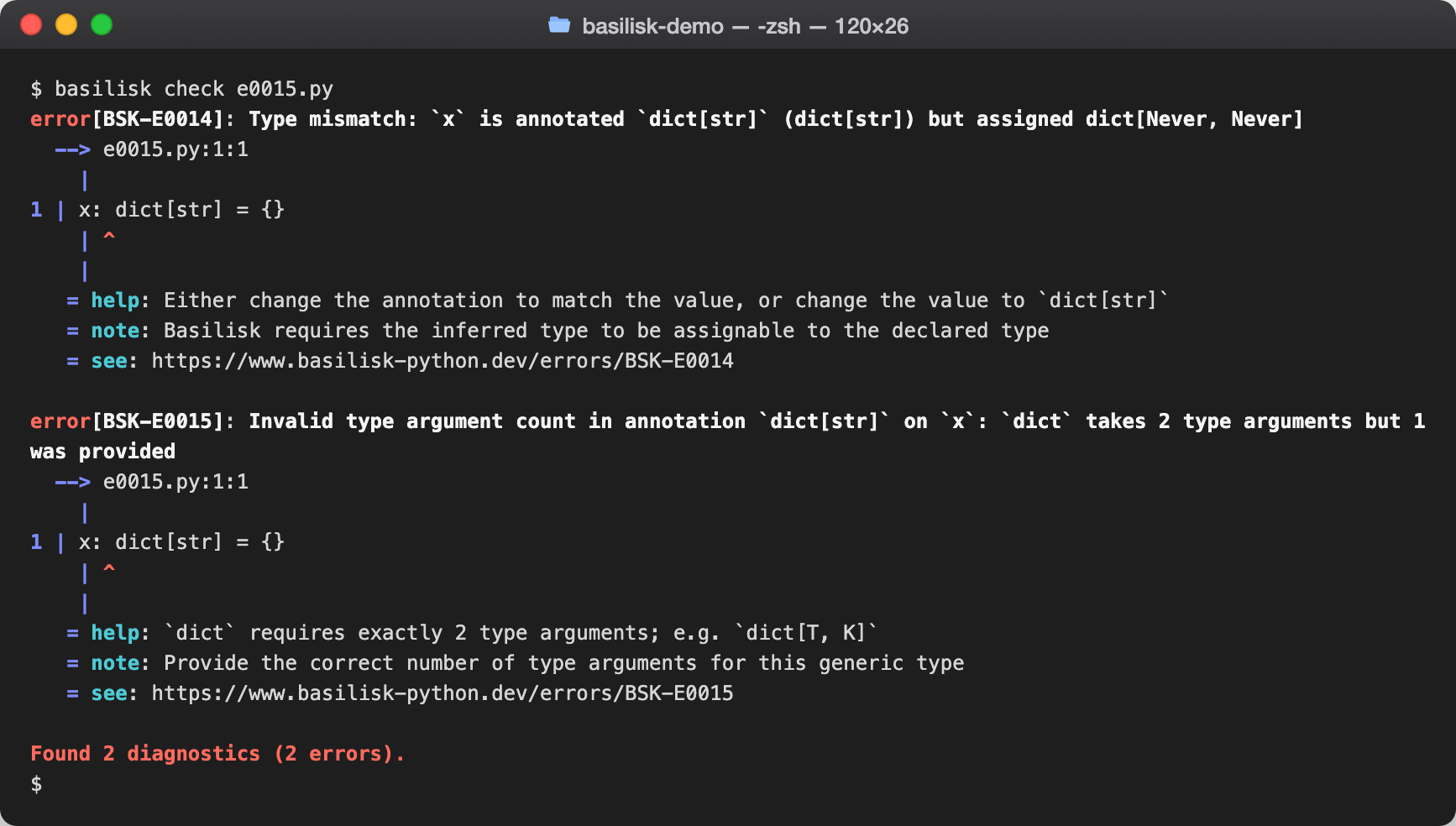
A generic type is used with the wrong number of type arguments.
x: dict[str] = {} # Error — dict requires 2 type argsReal basilisk check output:
classes_override — Incompatible method override
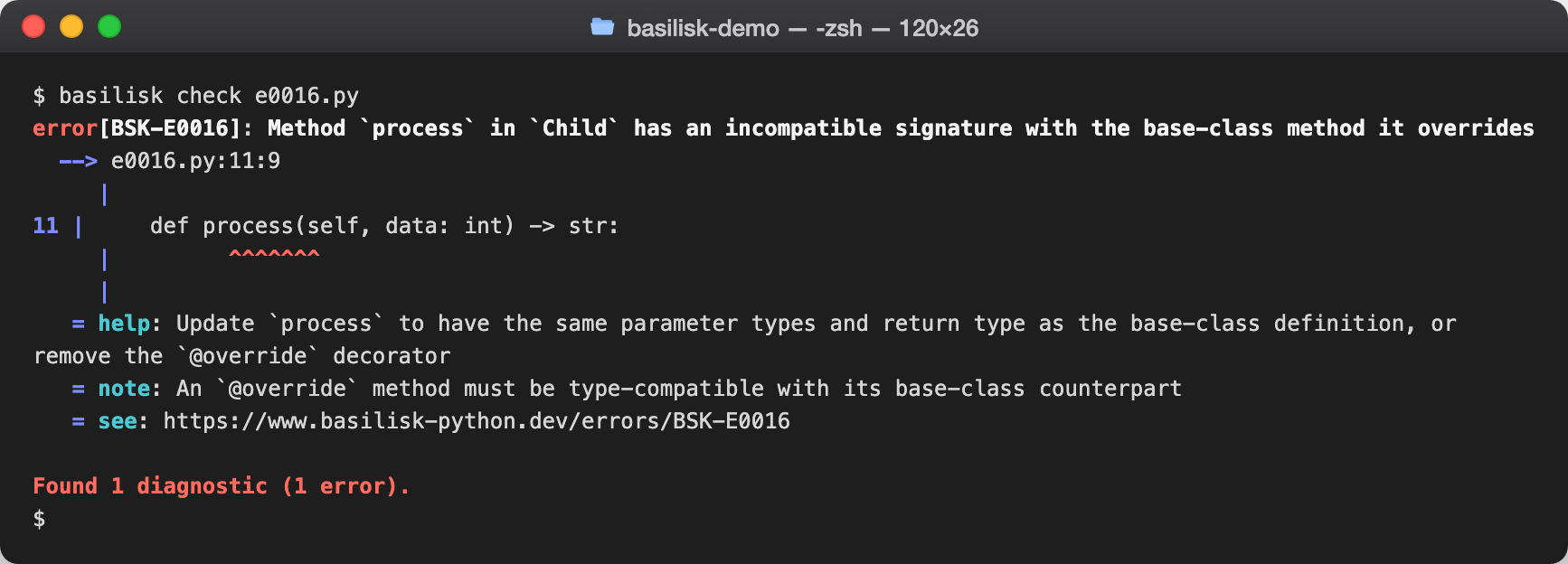
An overridden method in a subclass has an incompatible signature.
from typing import override

class Base:
    def process(self, data: str) -> str:
        return data

class Child(Base):
    @override
    def process(self, data: int) -> str:  # Error — parameter type changed
        return str(data)
Real basilisk check output:
classes_override_2 — Incompatible variable override
A class variable is overridden with an incompatible type in a subclass.
names_undefined — Undefined variable
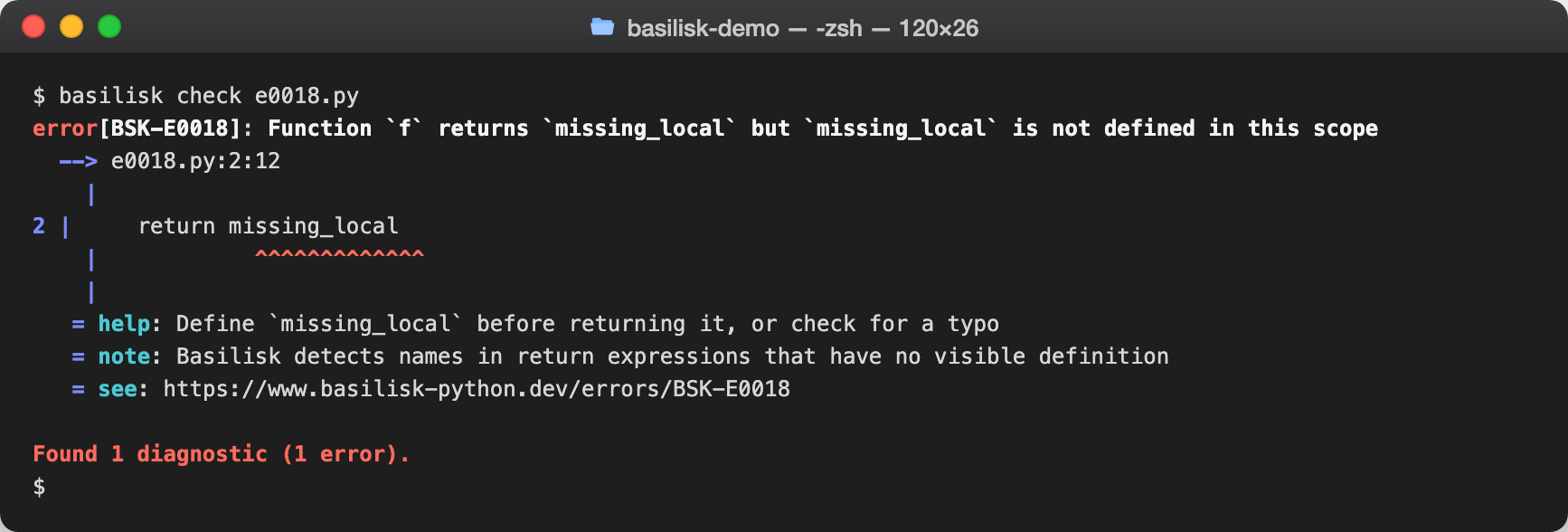
A name is used that has not been defined in the current scope.
def f() -> int:
    return missing_local  # Error — name is not defined
Real basilisk check output:
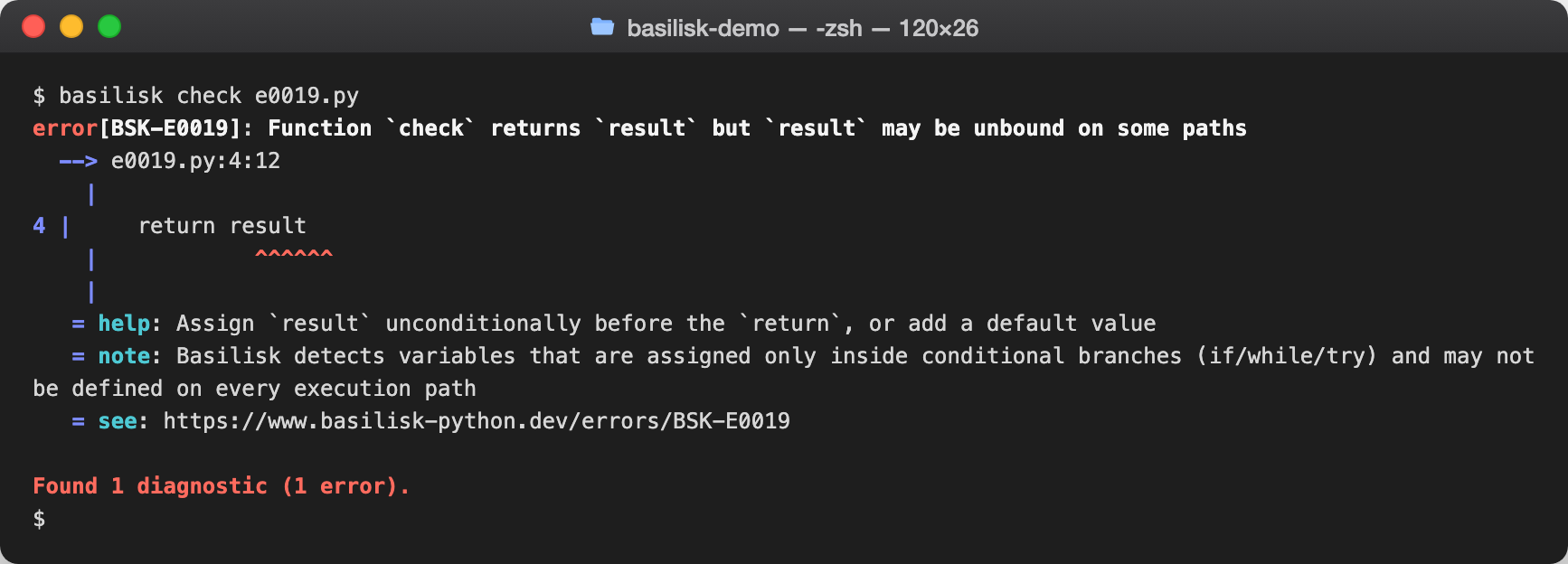
names_unbound — Unbound variable
A variable is used before it has been assigned a value in all code paths.
def check(flag: bool) -> str:
    if flag:
        result = "yes"
    return result  # Error — result may be unbound
Real basilisk check output:
overloads_definitions — Missing overload implementation
An @overload group has no concrete implementation function.
overloads_consistency — Overlapping overloads
Two @overload signatures are indistinguishable from the caller's perspective.
dict_key_hashable — Unhashable type in hash context
A mutable type (like list) is used as a dictionary key or set element.
d: dict[list[int], str] = {} # Error — list is not hashablematch_exhaustiveness — Non-exhaustive pattern match
A match statement does not cover all possible cases for the matched type.
def classify(x: int | str) -> str:
    match x:
        case int():
            return "number"
    # Error — str case not handled
annotations_typeexpr — Invalid type form
A value that is not a valid type is used in a type position — for example a numeric literal as an annotation.
x: 42 = 0   # Error — `42` is not a type
y: int = 0  # Correct
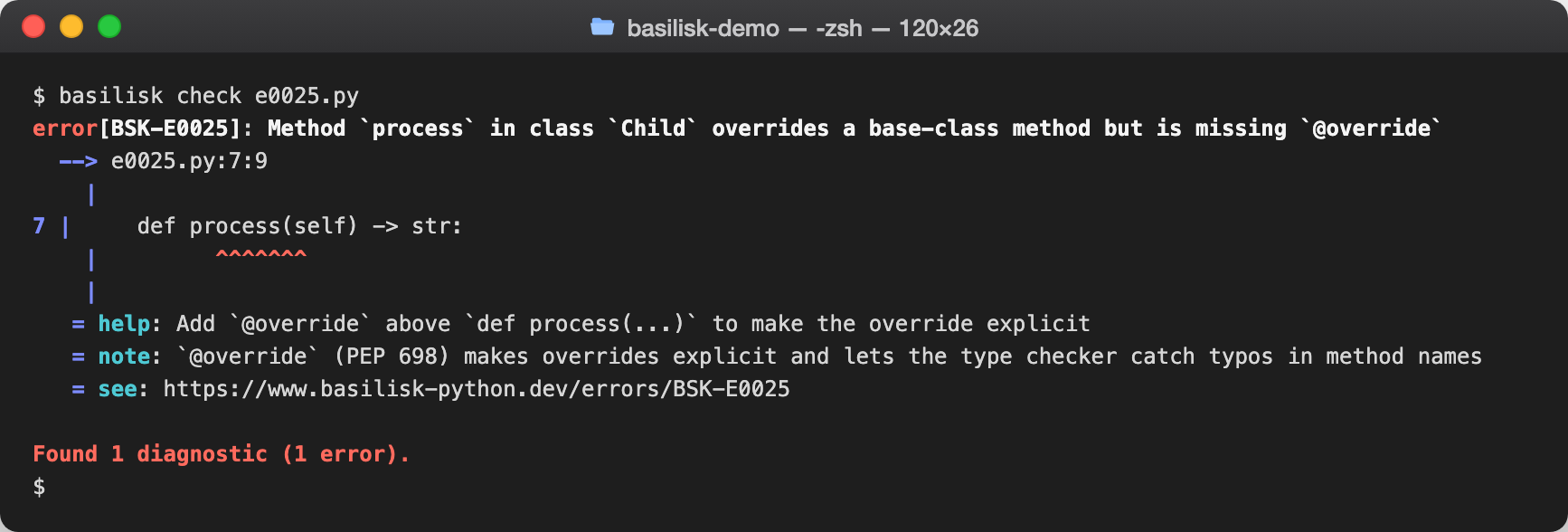
BSK-0025 — Missing @override decorator
A method that overrides a parent class method is missing the @override decorator (PEP 698).
class Base:
    def process(self) -> str:
        return "base"

class Child(Base):
    def process(self) -> str:  # Error — missing @override
        return "child"
Real basilisk check output:
generics_basic — TypeVar with a single constraint
A TypeVar declared with exactly one constraint is meaningless — constraints require two or more.
from typing import TypeVar

T = TypeVar("T", int)        # Error — a single constraint
U = TypeVar("U", int, str)   # Correct — two or more
generics_base_class — Duplicate TypeVar in a Generic[...] base
The same TypeVar appears more than once in a Generic[...] (or Protocol[...]) base.
from typing import Generic, TypeVar

T = TypeVar("T")
class Box(Generic[T, T]):  # Error — `T` listed twice
    ...
typeddicts_class_syntax — Method defined inside a TypedDict
TypedDict classes describe data shape only; they may not define methods.
from typing import TypedDict

class Movie(TypedDict):
    title: str
    def play(self) -> None:  # Error — methods aren't allowed in a TypedDict
        ...